
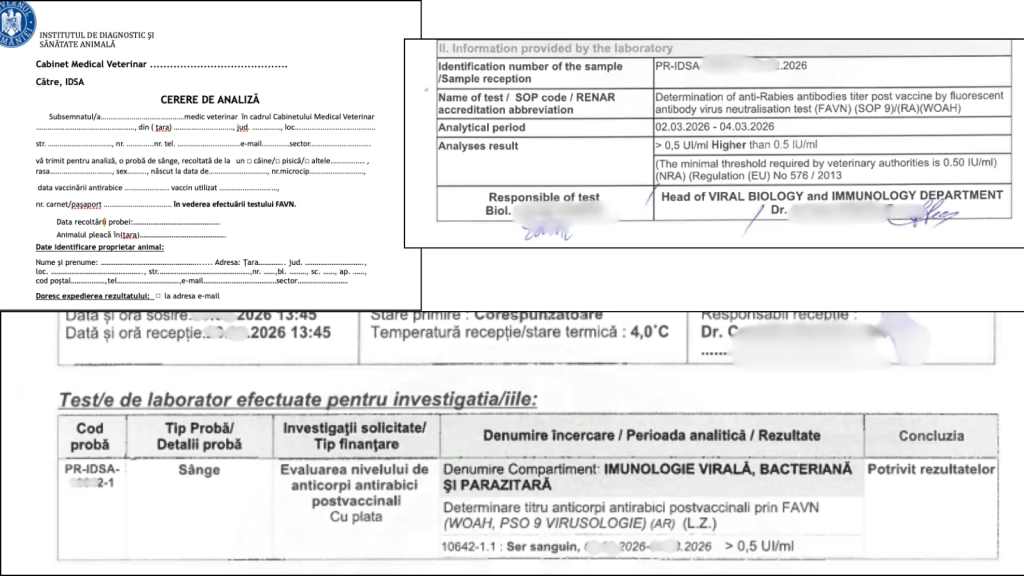
Are you living in Bucharest, visiting Romania with your pet or preparing for international travel? Joyvet provides pet microchipping in Bucharest for dogs and cats, microchip scanning and document checks, as well as blood collection and sample coordination for the FAVN rabies antibody test.
For FAVN testing, Joyvet checks the pet’s microchip, rabies vaccination and travel documents, collects the blood sample, prepares the submission paperwork and arranges temperature-controlled transport to the Institute for Diagnosis and Animal Health – IDSA – in Bucharest. The official laboratory test is performed by IDSA’s National Reference Laboratory for Rabies, not inside the Joyvet practice.
Before booking a travel-related appointment, please tell us:
- your destination country;
- every country through which you will transit;
- whether you plan to return to Romania or another EU country;
- your approximate departure and return dates;
- whether the rabies vaccination has ever expired.
Pet-travel requirements depend on the entire route, not only on the final destination.
Pet microchip and FAVN test prices at Joyvet
| Service | Current Joyvet price |
| Microchip implantation for a dog | 120 RON |
| Microchip implantation for a cat | 120 RON |
| RECS registration or database operation for a dog, when applicable | 50 RON |
| FAVN rabies antibody test service through IDSA | 850 RON |
The FAVN fee covers the microchip and document check, blood collection, preparation of the laboratory request, correct sample storage and refrigerated transport to IDSA. Vaccination, consultation, pet-passport services and any official sanitary-veterinary certificate required for the journey are separate services.
Prices may change, so please confirm the current fee when booking.
Pet microchip in Bucharest for dogs and cats
A pet microchip is a small passive electronic transponder implanted under the skin. It contains a unique identification number that can be read with a compatible scanner at veterinary practices, shelters and certain border-control facilities.
The chip does not contain a battery and does not continuously transmit information. It is activated briefly when a scanner is placed close to it and then displays its unique numerical code. A pet microchip is therefore not a GPS tracker and cannot show your pet’s live location.
The number can be connected to:
- the pet’s passport or health records;
- its rabies-vaccination history;
- an appropriate identification database;
- the owner’s contact details, where the applicable registry allows this.
The information is not stored as a complete medical record inside the microchip itself. The chip provides the identifier; the associated documents or database contain the relevant details.
Does pet microchipping hurt?
Microchipping is a short procedure, usually comparable to an ordinary injection. The veterinarian first scans the pet to make sure that a readable microchip is not already present. The new chip is then implanted under the skin with a sterile, single-use applicator and scanned again to confirm that it works correctly.
Anaesthesia is not normally required. Dogs and cats may feel a brief pinch, but the procedure usually takes only a few seconds and is generally well tolerated.
Microchipping may be booked as a separate procedure or combined with another veterinary appointment when medically and legally appropriate.
When should a pet be microchipped or scanned?
A microchip appointment may be needed when:
- your dog or cat has never been microchipped;
- you adopted or purchased a pet and need its identity checked;
- an existing microchip cannot be found or read;
- the number in the passport does not match the number detected by the scanner;
- you are relocating to Romania;
- you need an EU pet passport or another travel document;
- the pet needs a rabies vaccination for international travel;
- your dog needs to be entered or updated in Romania’s RECS system;
- you are preparing for a FAVN rabies titer test.
An existing foreign microchip should be scanned before any new chip is implanted. If the pet has more than one microchip, all relevant numbers may need to appear in its travel documents.
Dog microchipping and RECS registration in Romania
Romania operates the Registrul de Evidență a Câinilor cu Stăpân — RECS, the national register for owned dogs. Romanian rules require owned dogs to be identified with an approved microchip and registered according to the applicable deadlines. Puppies must generally be identified within 90 days after birth and, in any case, before sale, donation or access to public spaces.
For a dog that is becoming resident in Romania, changing ownership or requiring a Romanian database update, Joyvet can check which RECS operation is applicable. Bring the original health and ownership documents rather than relying only on photographs.
A dog visiting Romania temporarily may already have a valid foreign microchip and travel documents. The veterinarian should scan the chip and review the documents before deciding whether any Romanian database operation is necessary.
Cat microchipping in Bucharest
Domestic identification rules for cats are not identical to the RECS rules applying to dogs. However, a readable microchip is essential when a cat is being prepared for international travel.
Romania’s RomPetID portal now displays a register category for owned cats, so the older statement that there is no centralised possibility of recording microchipped cats should not be copied into the English page without qualification.
For travel purposes, the most important point is that the cat’s microchip number must correspond exactly with the number recorded in the passport, rabies-vaccination entry, laboratory request and any official health certificate.
The correct order: microchip, rabies vaccine and travel documents
For EU pet-travel purposes, the order of the procedures matters.
1. Implant or officially read the microchip
The pet must first be identified. The date of the rabies vaccination used for travel must not precede the date on which the microchip was implanted or officially read.
2. Administer the rabies vaccination
The authorised veterinarian should scan the chip before vaccination and record the correct microchip number with the rabies-vaccination details.
3. Observe the waiting period after a primary rabies vaccination
A primary rabies vaccination normally becomes valid for travel no earlier than 21 days after completion of the primary vaccination protocol.
A vaccination may also be treated as primary when the previous rabies vaccination expired, even if the interruption was brief. Timely boosters administered before the preceding vaccination expires preserve the continuity of the vaccination series.
4. Perform the FAVN test if the route requires it
When FAVN testing is required, blood may be collected at least 30 days after the primary vaccination. Under current EU rules, sampling may also be performed within an uninterrupted, currently valid rabies-vaccination series, although the destination country may impose additional timing rules.
5. Complete the appropriate travel document
Depending on the route and the owner’s residence, this may be an EU pet passport, an EU animal health certificate or a destination-specific official certificate.
Current EU rules confirm that the microchip must precede or be officially read before the rabies vaccination, that the primary vaccination becomes valid after at least 21 days and that FAVN sampling, where required, is carried out at least 30 days after a primary vaccination or within a valid continuous vaccination series.
EU pet passport or EU animal health certificate?
These documents should not be treated as interchangeable.
EU pet passport
An EU pet passport is used mainly for travel between EU countries and for eligible returns to the EU. Under current EU guidance, it may be issued only to a pet owner who is resident in the European Union. The rule concerns residence, not necessarily citizenship.
A foreign national legally residing in Romania may therefore be eligible, while a short-term visitor who is not resident in the EU should not automatically assume that a new EU pet passport can be issued during a brief stay in Bucharest.
For document preparation, read our guide to pet passports for dogs and cats.
EU animal health certificate
A pet travelling into the EU from a non-EU country generally needs an EU animal health certificate issued in the country of departure by the competent official veterinary authority, unless a recognised passport exception applies.
The certificate used to enter the EU is therefore not normally a document that a visitor obtains after already arriving in Bucharest. By contrast, a pet leaving Romania for a non-EU destination may require a different official sanitary-veterinary certificate prepared and endorsed according to that destination’s rules.
The EU confirms that the standard travel document for movement between EU countries is the EU pet passport, whereas entry from a non-EU country generally requires an EU animal health certificate. EU pet passports are issued only to EU-resident owners.
FAVN test in Bucharest: rabies titer testing for pet travel
The FAVN test is a laboratory blood test used to measure rabies-virus-neutralising antibodies produced after vaccination.
FAVN stands for Fluorescent Antibody Virus Neutralisation. Depending on the country, airline or official form, you may also encounter the terms:
- rabies titer test;
- rabies titre test;
- rabies antibody titration test;
- rabies serology test;
- rabies neutralising antibody test;
- RNATT – rabies neutralising antibody titre test.
These expressions are related, but travel authorities may specify an approved method or laboratory. The service coordinated by Joyvet is the FAVN method performed through IDSA.
The FAVN test does not diagnose rabies and does not look for rabies virus in the pet’s blood. It measures the immune response following rabies vaccination for administrative and travel-compliance purposes.
Do I need a FAVN test to travel with my dog or cat?
Not every international journey requires FAVN testing.
Travel between Romania and another EU country
For ordinary non-commercial travel between Romania and another EU Member State, FAVN is generally not required. The usual requirements are:
- a readable microchip;
- a valid rabies vaccination;
- a correctly completed EU pet passport.
Additional requirements may apply to particular destinations. Dogs entering Finland, Ireland, Malta, Norway or Northern Ireland generally require veterinary treatment against Echinococcus multilocularis between 24 and 120 hours before scheduled entry. This requirement applies to dogs, not cats or ferrets.
Travel from Romania to a non-EU country
Whether FAVN is required depends on the destination country. Some countries require the test for entry, while others do not.
The destination may also impose:
- a specific interval between vaccination and blood collection;
- a waiting period after the blood sample;
- an import permit;
- a country-specific health certificate;
- additional vaccinations or parasite treatments;
- laboratory or report-format requirements.
Returning to Romania or another EU country
Even when the destination does not request FAVN, the test may still be required for the pet’s return to the European Union.
Under current EU rules, pets entering the EU from a non-EU country or territory not included in the applicable exemption lists require an approved rabies antibody titration test. Only specifically designated and accredited laboratories may perform a test used for this purpose.
This is why the clinic must check the entire itinerary, including the return journey.
FAVN test timing explained
When can the blood sample be collected?
After a primary rabies vaccination, the sample may be collected no earlier than 30 days after vaccination.
If the pet has a continuously valid vaccination series and every booster was administered before the previous vaccination expired, current EU rules permit sampling within that valid series. Destination-specific rules may still require a particular interval after the most recent booster.
What is a passing FAVN result?
For EU pet-travel requirements, the result must be:
equal to or greater than 0.5 IU/ml
A result below 0.5 IU/ml is not accepted for the relevant travel procedure. It does not mean that the pet has rabies. The veterinarian will review the vaccination history and may recommend revaccination followed by repeat testing at an appropriate time.
Is there a 90-day waiting period?
Where the current EU rules require FAVN for entry from a non-listed non-EU country, the sample must be collected not less than 90 days before the date on which the accompanying animal health certificate is issued.
However, that 90-day period does not apply to the re-entry of a pet habitually resident in the EU when:
- the FAVN result was favourable;
- the test was completed before the pet left the EU;
- the result was correctly documented in the pet passport before departure.
Simply collecting the blood before leaving is not enough. The favourable result must already be available and documented.
How long does a FAVN result remain valid?
Under EU rules, a satisfactory result does not normally have to be repeated as long as every subsequent rabies booster is administered before the preceding vaccination expires.
If rabies-vaccination continuity is lost, the next dose may be treated as a new primary vaccination and the testing schedule may need to be restarted.
A non-EU destination can impose its own validity period, even when the result would remain valid for EU purposes. Always check both sets of rules.
How is the FAVN test arranged through Joyvet?
1. Travel-document review
At the appointment, the veterinarian scans the pet’s microchip and compares the number with the passport and vaccination records. The dates, vaccine name, batch number, validity period and owner details are also checked.
A laboratory result may be unusable for travel if the microchip number is wrong or if the underlying rabies vaccination does not satisfy the applicable rules.
2. Blood collection
Joyvet collects approximately 2.5–5 ml of blood in a sterile serum tube without anticoagulant. The procedure resembles an ordinary blood test and sedation is not required for most dogs and cats.
3. Sample preparation and documentation
The sample is prepared according to the laboratory requirements. Joyvet completes the analysis request and prepares readable copies of the relevant identification and vaccination documents.
4. Temperature-controlled transport to IDSA
Whole blood must be handled correctly and transported refrigerated rather than frozen. Joyvet manages the cold chain and delivers the sample to IDSA, so the owner does not have to carry the tube or arrange laboratory transport personally.
5. Official laboratory result
IDSA performs the FAVN analysis and issues the official laboratory report. According to the documentation used for Joyvet’s current service, the result may take up to three weeks, with possible extensions in special circumstances. The report is issued in Romanian and English.
Because travel calendars can include additional waiting periods and certificates, do not schedule the test only two or three weeks before departure.
What should you bring to your Joyvet appointment?
Please bring:
- your dog or cat;
- the original pet passport;
- the health booklet if it contains vaccinations or treatments not entered in the passport;
- any previous FAVN laboratory report;
- the complete destination and transit route;
- the expected departure and return dates;
- the owner’s current contact details;
- any import permit or destination-specific form already supplied by an embassy, authority or relocation company.
Joyvet checks the microchip, rabies-vaccination validity and document consistency before collecting the sample. If the vaccination has expired, the sample date is too early or essential information is missing, it is safer to correct the problem before the blood is sent.
Common mistakes that can delay pet travel
Rabies vaccination given before microchipping
A rabies vaccine administered before the pet was identified or officially scanned may not be accepted for international travel.
Allowing the rabies vaccination to expire
Even a short interruption can break the continuity of the vaccination series and turn the next dose into a new primary vaccination for travel purposes.
Collecting blood too early
After a primary or restarted rabies vaccination, collecting the sample before the required 30-day interval may make the result unusable.
Leaving the EU before the result is available
For an EU-resident pet relying on the re-entry exception, the favourable result must already be available and documented before the pet leaves the EU.
Incorrect microchip numbers
One wrong digit in the passport, laboratory request or vaccination record can delay the procedure or make the report difficult to use.
Checking only the destination
A country may allow the pet to enter without FAVN while the EU requires the test for the pet’s return.
Starting too close to departure
Laboratory processing is only one part of the timeline. The pet may also need a passport update, an official DSVSA certificate, parasite treatment, an import permit or airline approval.
Official sanitary-veterinary certificates for travel
The FAVN laboratory report and an official sanitary-veterinary certificate are separate documents.
The FAVN report confirms the laboratory result. A sanitary-veterinary certificate may also record:
- the pet’s identity;
- clinical health status;
- vaccinations;
- parasite treatments;
- FAVN result;
- additional destination-specific requirements.
Joyvet can help prepare the documentation and coordinate the procedure for obtaining a certificate through DSVSA Bucharest when the destination requires one. The correct model and issuance window must be checked for the individual country. This service is not automatically included in the 850 RON FAVN fee.
Frequently asked questions
Where can I get my dog microchipped in Bucharest?
Joyvet provides dog microchipping in Sector 3, Bucharest. The dog is scanned before implantation, scanned again afterwards and can be entered or updated in RECS when the relevant Romanian registration procedure applies.
Can Joyvet microchip a cat?
Yes. Joyvet provides cat microchipping for identification and international-travel preparation. The procedure is brief and normally does not require anaesthesia.
How much does a pet microchip cost in Bucharest?
At the time of publication, microchip implantation at Joyvet costs 120 RON for either a dog or a cat. A dog RECS registration or database operation costs 50 RON when applicable.
Can a microchip track my dog or cat?
No. A standard pet microchip is not a GPS device. It provides a unique identification number only when it is read with a compatible scanner.
Does my pet need a microchip before a rabies vaccine?
For international travel under EU rules, the microchip must be implanted or officially read before the rabies vaccination used for travel. The veterinarian should scan the chip and record the correct number with the vaccine entry.
Do I need a FAVN test to travel within the EU?
Usually not. Standard non-commercial travel between EU countries generally requires a microchip, a valid rabies vaccination and an EU pet passport. Individual destinations may impose additional requirements.
How long after a rabies vaccination can the FAVN test be performed?
After a primary rabies vaccination or after a lapse in vaccination, blood may be collected no earlier than 30 days after vaccination. Sampling may be possible within a continuously valid vaccination series, subject to the destination’s requirements.
What FAVN result is accepted for EU travel?
The result must be at least 0.5 IU/ml.
How long does the FAVN test take in Bucharest?
Joyvet’s current guidance advises allowing up to three weeks for the IDSA laboratory result, with the possibility of a longer interval in special circumstances. Additional waiting periods required by the destination or EU entry rules must be added separately.
Does my dog or cat need to fast before the FAVN blood test?
The IDSA instructions used for this procedure do not specify mandatory fasting solely for FAVN testing. If other blood tests are planned during the same appointment, the veterinarian may give separate feeding instructions.
Is a FAVN test valid for life?
It may remain valid indefinitely for EU purposes if all rabies boosters are administered before the preceding vaccination expires. The destination country may apply a different validity rule.
Can I leave the EU while waiting for the FAVN result?
You may physically leave, but doing so can create serious problems when returning. To benefit from the EU re-entry exception, a favourable result must be obtained and documented before the pet leaves the EU.
Can Joyvet arrange the official travel certificate?
Joyvet can assist with the DSVSA Bucharest certification procedure when an official certificate is required. The certificate is separate from the FAVN test and depends on the destination’s current requirements.
Book a pet microchip or FAVN test in Bucharest
Call: +40731803803
WhatsApp: +40731803803
Address: 68 Dumitru Papazoglu Street, Sector 3, Bucharest
Email: joyvetbucuresti@gmail.com
When contacting the practice, please provide:
- dog or cat;
- current microchip status;
- date of the latest rabies vaccination;
- destination country;
- transit countries;
- approximate travel date;
- whether the pet will return to Romania or another EU country.
Joyvet can check the microchip and documents, determine the appropriate sampling date, collect the blood, prepare the laboratory paperwork and arrange refrigerated transport to IDSA.
Learn more about our English-speaking veterinary clinic in Bucharest.
Important travel reminder
Pet-travel rules can change. Always verify:
- the country of destination;
- every transit country;
- the conditions for returning to the European Union;
- the requirements of the airline or transport company;
- the latest official veterinary certificate model.
Last reviewed: 24 August 2026